Kiyumizudera

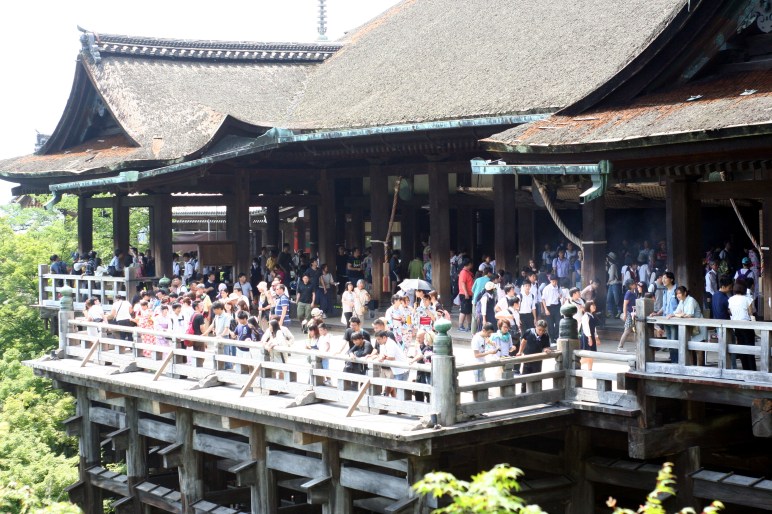
“To jump off the stage at mizudera” is a famous saying in Japan, meaning something akin to taking a risk without knowing the outcome can be worthwhile. It’s said that if you leap off the balcony of the stage here (and survive), any wish will be granted. Given that the fall is almost 200 feet, that seems a fair trade. Nowadays everyone gets fussy if you try to leap off the stage, so I can’t really recommend that, but the entire grounds are quite amazing.


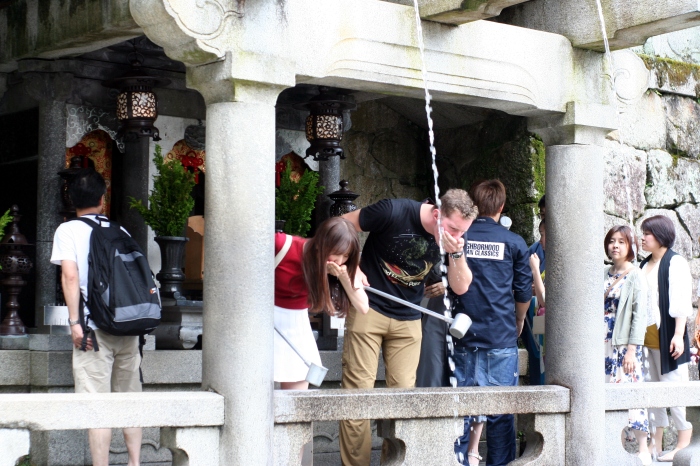
The temple was built in the 1600s and the main structure (title image) was built without using a single nail. The trek up to the temple is a decent walk, but since it sits high on a hill, you’re rewarded with some pretty spectacular views. I lucked out and we arrived as the day was clearing up; you could see most of Kyoto. The temple’s name comes from a waterfall that feeds its large fountain, Otawa-no-taki, roughly translated, kiyumizu is pure/clean water. The fountain itself is said to grant longevity, which is helpful if you intend on jumping off the stage. The fountain also has wish-granting abilities, if you want to forgo the stage dive.
kiyumizudera17.JPG


Jishu-jinja Shrine

One of the coolest parts of the temple complex is the small shrine dedicated to love (or lover’s vengeance anyway). We almost skipped the little shrine of Jishu-jinja, which would be a huge mistake. Though tiny, the shrine is jam packed with lovely features. Dedicated to Okuninushi, a sort of match-making deity. There is an old tree where women would hammer dolls to curse their enemies in the middle of the night by the power or Okage-myoojin.

In the main path of the shrine are two large stones, about twenty feet apart. These are the love stones. If you can walk from one to the other with your eyes shut you will be lucky in love. You can have others help you though it means you’ll need help with love later in life.
kiyumizudera13.JPG


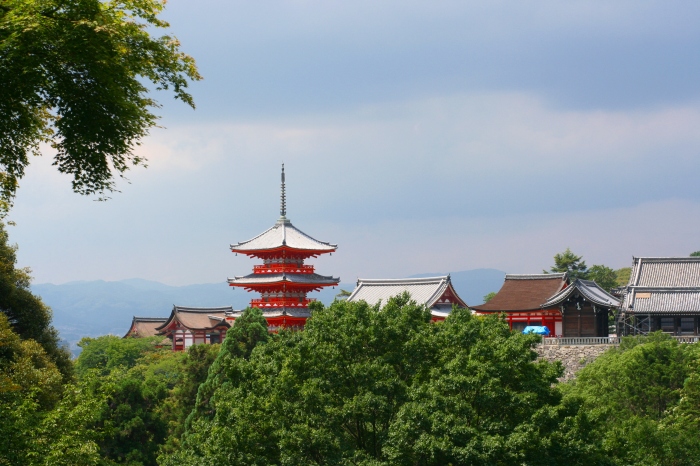
If I had to rate the must see temples in Kyoto, this would definitely make the top two. If you’re going to Kyoto, make sure you set aside a few hours for Kiyumizudera. Just walking the grounds will take the better park of an hour, and that isn’t including Jishu-jinja or the twenty-plus minute wait for Otawa-no-taki (which is worth it by the way). Definitely take the time to see one of the greatest man-made structures in Japan.

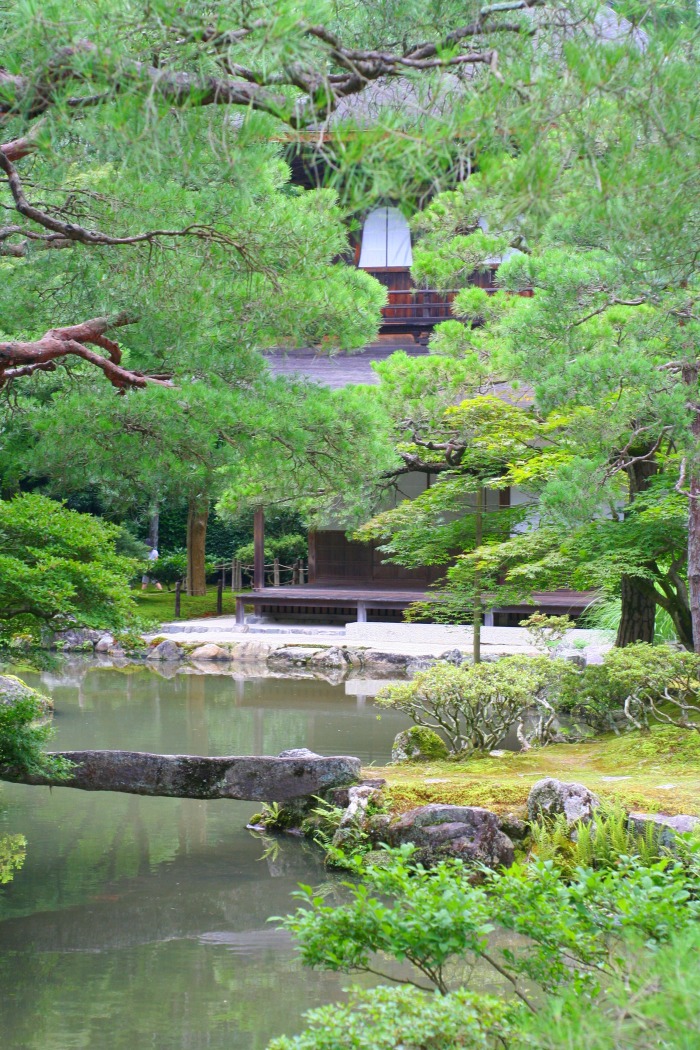


Ginkakuji, the Silver Pavilion

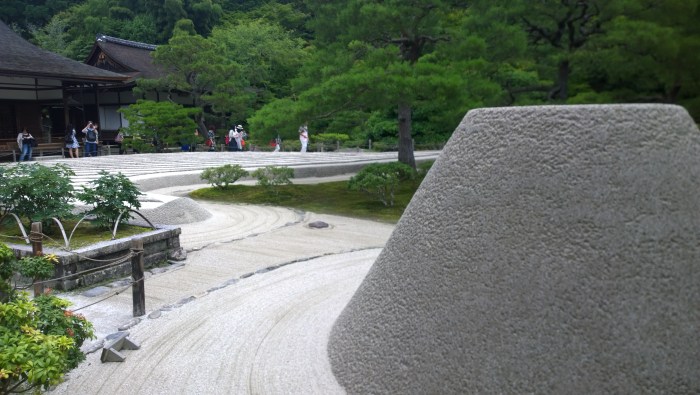
The silver pavilion is silver in name only. The temple was modeled after Kinkakuji, the Golden Pavilion, and is a reflection of the top two stories. This was dreamt up by the grandson of the designer of Kinkakuji, Ashikaga Yoshimasa. Although the plan was to cover the pavilion in silver foil, this never came to fruition before the death of the owner and the temple has remained in this condition since. Ginkakuji’s structure is actually older than the pavilion it was modeled after, since Kinkakuji was burned down and rebuilt around the 1950’s.

ginkakuji2.JPG

However, I knew little of the temple’s history before arriving there, and had actually walked through the entire grounds and was about to exit before I realized that the silver pavilion was, in fact, the rather plain structure at the beginning of the walk. I was expecting a sight as impressive as Kinkakuji. That isn’t to say the temple isn’t worth visiting, just temper your expectations appropriately. The grounds are lush and pleasant to walk through, and the crowds are far less dense than at Kinkakuji.


WP_20160626_11_56_56_Pro__highres.jpg

Toji Temple

The crowning feature of Toji Temple is its five story pagoda. We had almost skipped this temple due to time constraints but I’m glad we didn’t. Aside from the impressive pagoda itself and the beautiful treasure houses, I found a great sense of peace at Toji.

Full album here

The pagoda is an impressive piece of architecture rebuilt in the Edo period and the temple itself was established around 800 A.D.; the only surviving Buddhist temple in Kyoto from that time. Perhaps more impressive than the pagoda are the treasure houses though. Three buildings house incredible sculptures of buddhas standing over ten feet high, and dozens of other sculptures of spirits and deities made from wood, stone or bronze (gold?). The lighting in the buildings really captures the sculptures perfectly though, simulating candlelight quite well. They must be another sight entirely when the walls were opened. Unfortunately, like many of the most beautiful sights in Kyoto, no photographs are allowed. I do encourage a visit to Toji to see the pagoda and the beautiful sculptures within the temple though. You can walk to Toji from Kyoto station in ~20 minutes, and it is absolutely worth your time.

It is a very peaceful place.

A few steps away from the pagoda two women were giving away plum tea with flecks of gold in it. As we sat sipping on tea looking at the pagoda I realized that my life has been pretty damned amazing so far, and I did not need to rush into anything. I had been struggling with the feeling of life passing by faster and faster while I felt like I was standing still. We can get so caught up with running sometimes, we forget where we were going in the first place. Toji reminded me that it’s a good thing to sit down and reflect on occasion, or you might miss what you’ve passed by. My personal growth, both at my last job in the U.S. and in the few months that I have been in Japan has been astounding. Every six months we learn so many things and grow in so many ways, but we can get so bogged down in the stresses and daily minutiae that this can be lost on us. If you haven’t recently, I encourage you to find a good bench somewhere, pour yourself a good cup of whatever, and reflect on how much you have experienced and grown in the past few months of your life. It will be worth the time.

Kinkakuji, the Golden Pavilion

Possibly the most famous shrine in Kyoto, the Golden Pavilion is an opulent and beautiful sight. The top two floors of the building are coated in a thick layer of gold that makes it shine even on an overcast day. The official name for the temple is Rokuon-ji, or the Deer Garden Temple, although I saw no signs of deer there, but it is generally referred to as the Temple of the Golden Pavilion (Kinkakuji). The gold symbolizes purity and is meant to ward off negative thoughts of death. The temple was burned down in the ’50s by a young monk, so the current temple is technically a recreation of the original. The modern gold leaf is 5x thicker than the original coat as well. Actually, when the temple was first built as a residence in the 14th century, only the ceiling of the top floor was covered in gold. Each floor of the pavilion was designed in a unique architectural style. The bottom floor, the ‘chamber of dharma waters’ is open to the surrounding water and gardens with half walls, allowing one to enjoy nature unspoiled, while the second floor ‘the tower of sound waves’ was designed in the same style as samurai houses. The third floor was designed according to zen principles and is called the ‘cupola of the ultimate.’

Full gallery here.

Unfortunately, since we had traveled to Kyoto in the middle of the rainy season, there was a steady soaking rain the entire time we explored the temple. This didn’t stop the crowds though, the entire grounds were quite crowded all through the trails around the temple and gardens. I know I’ve said this before, but this is a site you must visit if you go to Kyoto even for a day. There were some pictures of the temple in the snow at the giftshop and it is really stunning then. The gold exterior is magnificent surrounded by white snow. Braving the mobs of people and the rain allowed for some stunning views of the temple across the water. Photos don’t really do it justice. The walk through the gardens after you pass the temple was really relaxing as well. As was the green tea served towards the end of the tour (for a nominal fee). Sitting and drinking tea out of the rain with a soothing natural view in front of you is a fine way to melt your stresses away. Especially with some fine company.